Free Silicon Conference 2026
Between 6th and 8th of July I visited Free Silicon Conference (FSiC2026), that by the merit of co-organizer prof. Dr. Árpáda Bűrmna happened in Ljubljana, Slovenia, at the Faculty of Electronics. Slovenia has a big deficiency in these kinds of events, which made me even more eager to plan my participation at the FSiC2026.
My visit of FSiC2026 happened quite spontaneously. I found the event invitation on Fediverse, and I was surprised to see it's going on in my hometown of Ljubljana. I dug in deeper on the announcement and when I saw that NGI0 is co-sponsoring the event, my decision to visit the conference was made. After all deliver presentations and/or otherwise create a presence at relevant FOSS and R&D events is one of my work obligations as NGI0 regional representative. I contacted organizers, and they kindly allowed me to set up a booth at the conference. I had no idea how much recognition will NGI0 and NLnet have at the conference.
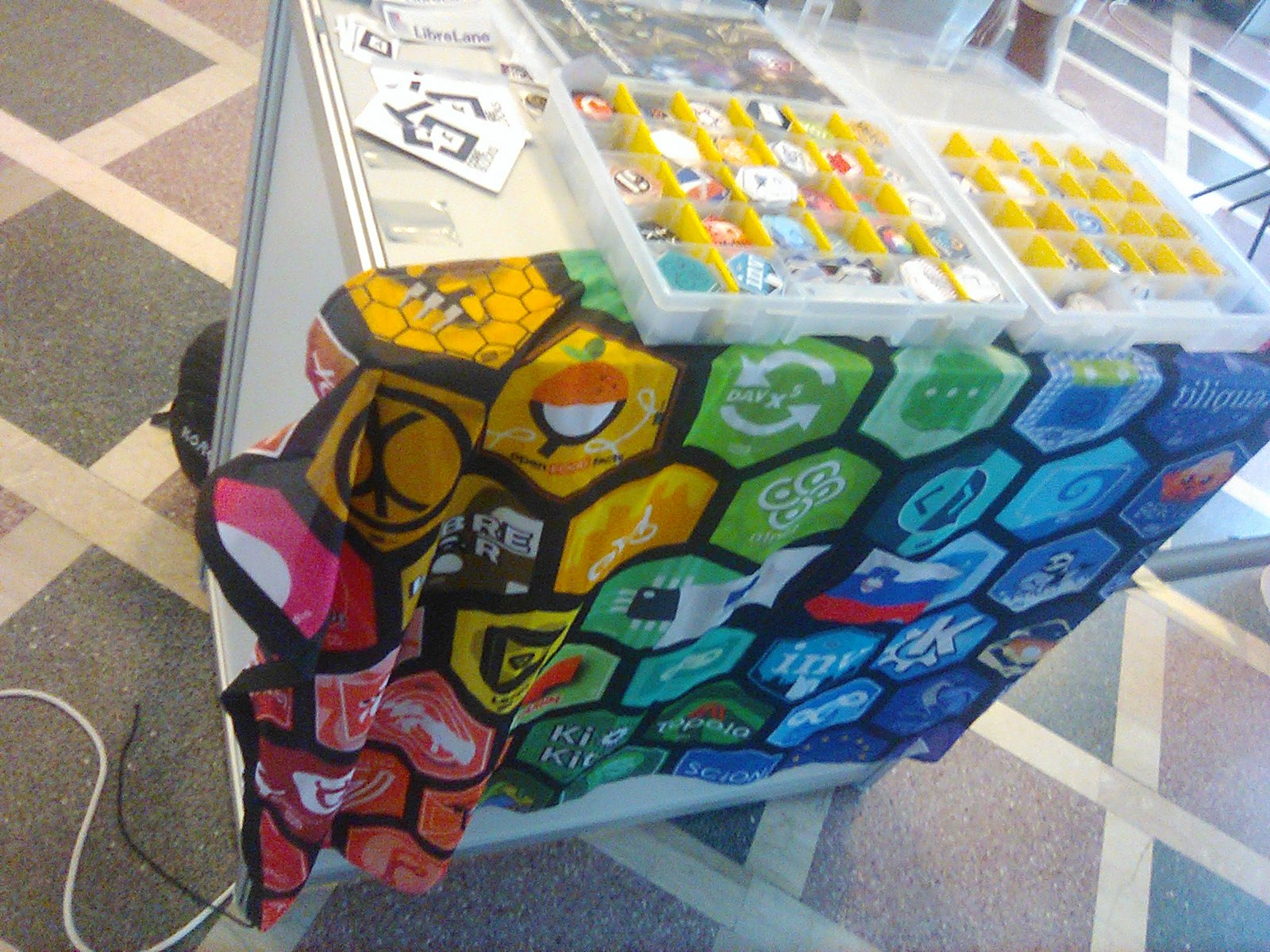
Figure 1: NGI0 booth.
Before my visit of FSiC2026 I did not know much about the chip production ecosystem. Intuitively I thought the field is dominated by the big industry, which has its hold over the education sector as well. I was not too optimistic about the subsidies and legislation European Union was adopting to boost its chip industry (Cips act 1.0 and 2.0), since I'm of opinion that EU is lagging too much behind the USA and eastern Asia. (EU legislation usually looks like sweet talk to me and at the same time it is too long and full of hard to understand bureaucratic language.)
My knowledge of free and open source hardware field is limited to my endeavors with Arduino and KiCad at PifCamps, my organization of year-long workshop to build DIY Dactyl keyboards, a few visits of open hardware presentations at FOSDEM and my personal acquaintance with the author of Balthazar project (open hardware laptop sponsored by NGI0, I'm a fan of MNT Reform as well). Being honest, I never gave too much thought to the field of Free and Open Source Hardware since I'm more interested in software and web.
I was pleasantly surprised when I read on the official Free Silicon Foundation website that their goal is to expand copyleft to the field of chip design and Computer-Aided Design (CAD) tools. F-Si advocates for free silicon, not merely open silicon. Copyleft goes one step further than the concept of openness in the term Open Source, since it requires that derivatives of the original work remains free and open, protected by the same license. The GNU project, that started Free Software (copyleft) movement is now over four decades old, while Free Silicon Foundation (FSF) was established in 2019 and is itself also member of NGI0 coalition. It's promising sign that the copyleft is expanding to new fields in this case to the field of CAD software and chip design. For a very nice overview over "opening" of this field I'd like to point to the recent article from the Linux Magazine: Changing the Chip Industry: How Public Investment Has Grown Open Silicon.
If I turn to the conference itself, I can say that most of the presentations were above my knowledge of electronics. I could say they seemed as a complete magic according to the third law of science fiction author A. C. Clark. Luckily for me, I knew locals from the Faculty of Electronics that were live translating the unknown abbreviations, simplifying scientific terms and summarizing presentations. All the slides from presentations are already available at the official website of the FSiC2026. Presentations I was able to understand were the ones about licenses. Yet again I was amazed by the proposal of Hardware General Public License (HGPL) that is currently in draft phase, to include a clause that would require copyleft license for firmware of the chip as well. If this clause gets into the final text of the license, it would be like killing two birds with one stone.
Unfairly to other great presentations from the FSiC2026 I'd like to shed the light to the One Student One Chip program by Chinese Academy of Sciences launched in 2019, that is empowering students to graduate with a processor chip designed entirely by themselves. Everyone can enroll in the program (Chinese citizenship is not required) and there is no time limit imposed. Students have to take detailed notes on their learning process. In the midterm test mentor injects a bug into the chip circuit and student has to debug and fix the error. Students that finish the program get their chips taped-out for free. And a truly fascinating number: almost 20 thousand students are currently enrolled into the One Student One Chip program.
My attention was also captured packaging of EDA (Electronic Design Automation) tools into Guix. I'm an enthusiastic Guix operating system user myself and two time visitor of a Guix Days unconference in Brussels. The most important benefit that Guix brings to researches is reproducibilty, which enables independent verification of research results that include software and computation. Software is getting fixed, upgrading and updating constantly, so there's a high possibility that the software or any of libraries it depends on won't properly build or work after certain amount of time. Modern software is usually not just a peace of source code, but is a bundle of dependencies which in turn have their own libraries they depend upon. On top of that a properly set environment is crucial for running and building complex software stacks. Partially this is addressed by virtualization tools, which comes native in Guix, but Guix goes a step further by locking down the versions of the pieces of software running in the virtual environment, making sure that consecutive builds of the research software and the environment that it runs in are exactly the same as it was in original research.
Videos of presentations from former Free Silicon Conferences are posted on Free Silicon Foundation Peertube instance, I suppose that recordings of this year's conference will be uploaded shortly.
In conclusion, I'd like to return to the NGI0 program, that I did not have to extensively present. For that I have to thank to many presentations that were presented by NGI0 grantees or were using the CAD and/or EDA software projects that received NGI0 funding and other kinds of support (NGI0 also helps with licensing, community building and mentoring, business circle, internationalization, standardization, testing among other support services - see full list). Here's my list of presented projects with NGI0 support:
- NLnet; Naja
- Verilog-A distiller
- VACASK
- gnucap:start [*]
- FrugalEDA documentation
- LibrePDK - LibreSilicon
- Mosaic
- kuznia-rdzeni/coreblocks: RISC-V out-of-order core for education and research purposes
You can find many more electronic design projects by entering CAD or EDA search terms to the search filter on the list of all NGI0 supported projects' website. That's why my work at the NGI0 booth was very easy. Many visitors came by to give acknowledgement and praise to NGI0. I received some questions about news that broke out two years ago, that European Commission ended financial support for NGI0 (I've reported about this in my radio show (in Slovene) with Pierre-Yves Gibello from OW2 as a guest). To that I can say that NGI0 will reform into Restack program under a new EC initiative called Open Internet Stack and two new members are being added to the new coalition. Other booth visitors were asking about possibilities and conditions to apply for grants. Everyone that came by also took some stickers with them, and we ran out of all Free Silicon Foundation stickers as well as all other stickers with logos of projects related to free and open source hardware. NLNet has to take a note to print new ones for the next edition of the Free Silicon Conference.
I've hosted prof. Dr. Árpád Bűrmen in my radio show (fully in Slovene) discussing the FSiC2026 and copyleft movement in chip design, and I was delighted to see that Radio Student where my shows are published was not the only Slovenian media that covered the FSiC2026. Slovenian National Press Agency and Bloomberg Adria TV reported on the FSiC2026 as well.